
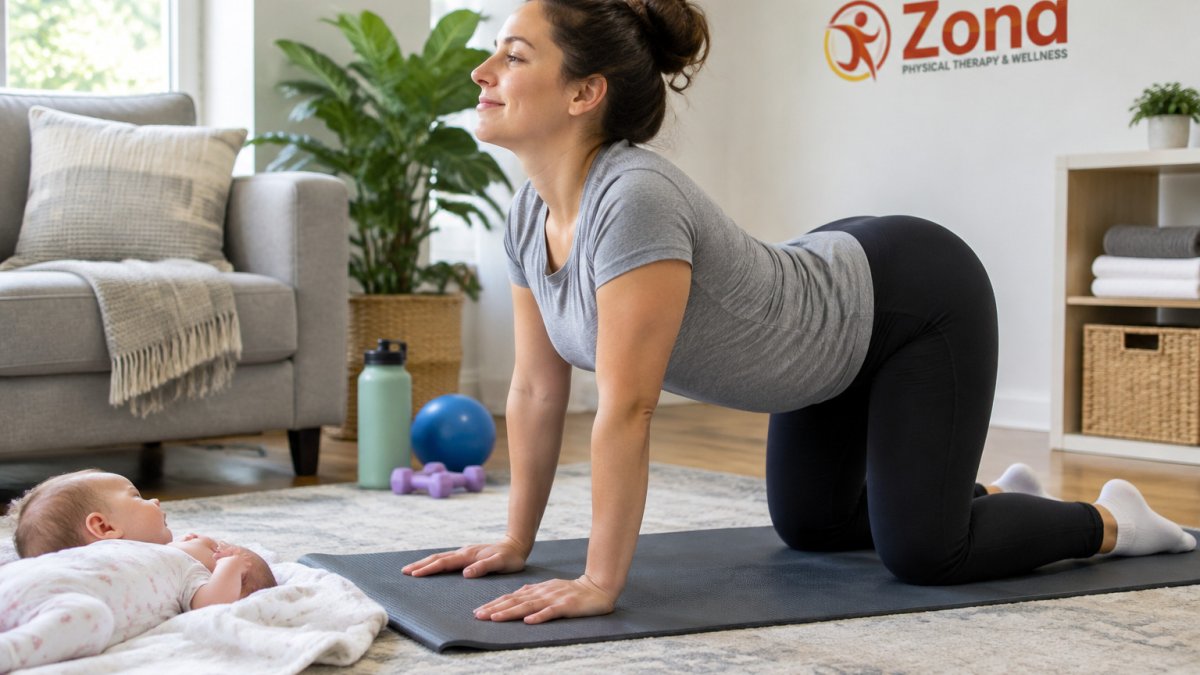
Last Updated: November 15, 2026
Quick Summary
Back pain after pregnancy exercises should start gently with one set of five to eight slow repetitions of cat-cow, pelvic tilts, glute bridges, and heel slides, once a day, three to four days a week. Add walking and posture work, and progress one variable at a time only when symptoms are not worse the next day.
- Rest 30 to 60 seconds between exercises and keep early sessions under 15 minutes.
- If pain rises during exercise and settles within an hour, scale back.
- Bring the baby to you when feeding, use a pillow under your elbows, and keep feet flat.
- After a C-section, wait for your provider's clearance and skip crunches, planks, and heavy lifting.
- Seek physical therapy if pain lasts beyond a few weeks or limits daily tasks.
Table of Contents
- Why Back Pain After Pregnancy Happens and When to Start Exercising
- Lower Back Pain After Pregnancy Exercises for Core and Glute Support
- Upper Back Pain After Pregnancy Exercises for Posture and Feeding Positions
- Back Pain After C-Section Exercises and Safe Modifications
- How Long Does Back Pain Last After Giving Birth and When to Seek Physical Therapy
- Building Your Postpartum Back Pain Exercise Routine at Zona
- Frequently Asked Questions
Why Back Pain After Pregnancy Happens and When to Start Exercising
Back pain after pregnancy exercises work best when they match what your body has been through. If you want that kind of one-on-one support, our pregnancy and postpartum physical therapy in Buford, GA is built around exactly that. Back pain is common during pregnancy, and for many women that discomfort carries into the weeks after delivery (value is what Coveo indexes and uses as the title in Search Results.--> <title>Back Pain...).
Back pain after pregnancy usually comes from three things: weak deep core muscles, pelvic floor changes, and repeated strain from feeding and carrying. The good news is that gentle, targeted movement helps.
When can you start? The American College of Obstetricians and Gynecologists' guidance on exercise after pregnancy advises beginning with simple exercises that strengthen major muscle groups, including the abdominal and back muscles.
What You'll Need Before Your First Session
- A firm mat or carpeted floor
- A pillow for support
- Loose, comfortable clothing
Keep sessions short at first. Stop if you feel pain.
Lower Back Pain After Pregnancy Exercises for Core and Glute Support
The best lower back pain after pregnancy exercises rebuild the deep core and glutes without straining healing tissue. If you are concerned about core support or abdominal separation, our core and abdominal rehabilitation in Buford, GA offers one-on-one guidance.
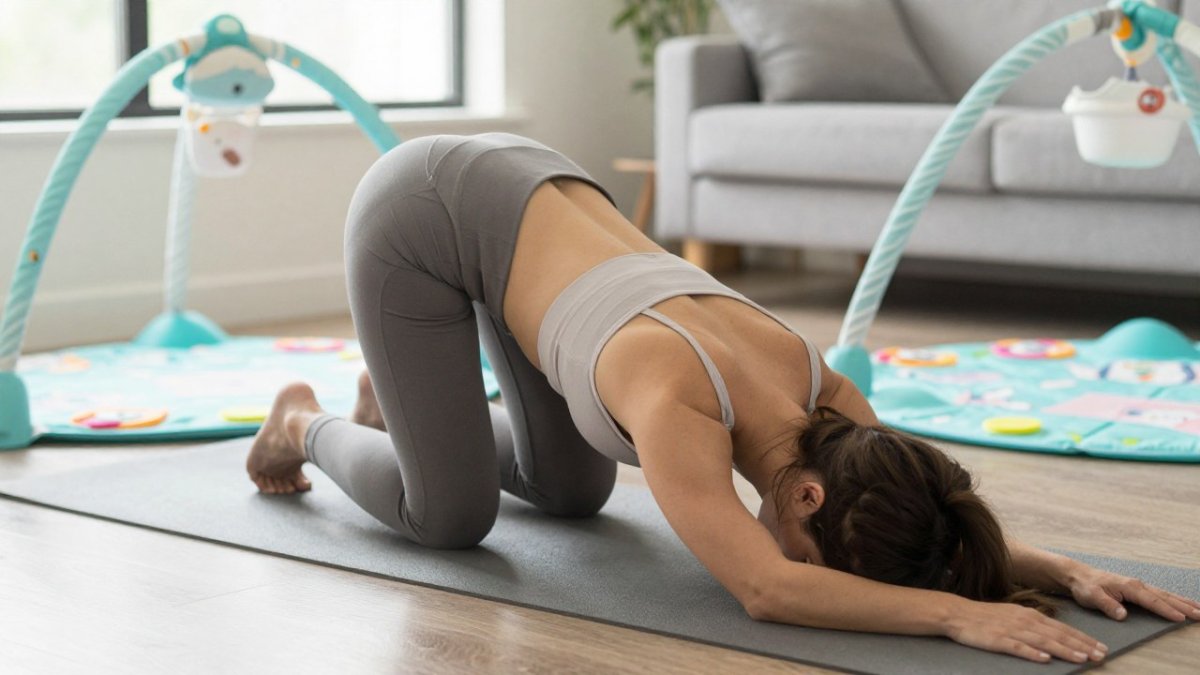
The Starting Set
Begin with one set of five to eight slow repetitions of each move, once a day, three to four days a week. Rest 30 to 60 seconds between exercises. Quality beats quantity: a slow, controlled repetition with a full exhale is worth more than ten rushed ones.
- Cat-cow stretch: On all fours with hands under shoulders and knees under hips, inhale as you gently arch and lift your chest, exhale as you round your spine and tuck your tailbone. Move one segment at a time, about three seconds each direction.
- Pelvic tilts: Lie on your back with knees bent and feet flat. Exhale, draw your lower abdomen in gently, and press your lower back toward the floor. Hold two to three seconds, then release fully.
- Glute bridges: Lie on your back, knees bent, feet hip-width apart. Exhale, press through your heels and lift your hips until your body forms a straight line from knees to shoulders. Squeeze your glutes at the top for two seconds, then lower slowly.
How to Progress Without Flaring Symptoms
Progress one variable at a time, not all at once.
A simple guideline: if pain rises during an exercise and settles within an hour, scale back. If pain is unchanged or better the next morning, you can hold that level or progress gradually.
Watch out: Glute bridges and pelvic tilts can feel like they are working the core when the real driver is breath-holding.
Pelvic Floor Activation and Breathing
Pelvic floor activation is the practice of gently contracting the muscles that support your bladder and bowel, then fully releasing them.
Try this breathing exercise: inhale and let the pelvic floor relax and drop, exhale and gently draw it up, as if stopping gas.
Do not hold your breath or clench hard. A pelvic floor physical therapy in Buford assessment can check your technique in a private, one-on-one setting.
A Weekly Structure You Can Actually Follow
Alternate the core and glute work with walking and mobility so no single tissue gets loaded every day:
| Day | Focus | Dosage |
|---|---|---|
| Monday | Core and glute set | 1 set of 5-8 reps each, 10 minutes |
| Tuesday | Walking | 10-15 minutes at a comfortable pace |
| Wednesday | Core and glute set | 1-2 sets of 8 reps each |
| Thursday | Posture and upper back | See the posture section |
| Friday | Gentle mobility and breathing | 10 minutes |
| Weekend | Walking and rest | As tolerated |
Keep the whole session under 15 minutes at first. Short, frequent sessions beat one long one, especially in the early weeks.
Upper Back Pain After Pregnancy Exercises for Posture and Feeding Positions
Upper back pain after pregnancy exercises should target the muscles that round forward during feeding. Hours spent hunched over a newborn tighten your chest and weaken your upper back.
Try these daily:
- Shoulder blade squeezes: Pull your shoulder blades back and down, hold five seconds.
- Doorway chest stretch: Place your forearms on a doorframe and lean gently forward.
- Chin tucks: Draw your chin straight back, hold, release.
Fix your setup, too. Bring the baby to you rather than leaning down. Use a pillow under your elbows, keep your feet flat, and put a support behind your lower back.
Back Pain After C-Section Exercises and Safe Modifications
Back pain after C-section exercises need extra care around a healing incision and abdominal wall. Most exercise lists treat cesarean recovery as a single phase. In practice, it moves through stages, and the right exercise depends on where you are.
Stage 1: The First Two to Six Weeks (After Provider Clearance)
Focus on breathing, circulation, and gentle reconnection rather than strengthening. Safe early moves include:
- Short walks, starting with five to ten minutes and building gradually
- Diaphragmatic breathing: inhale into your ribs and belly, exhale slowly, letting the pelvic floor relax
- Gentle pelvic tilts in lying, small range only
Skip crunches, sit-ups, planks, heavy lifting, and anything that pulls or burns at the scar. Support your incision with a pillow when you cough or laugh.
Watch out: A common mistake is returning to core work because the scar looks healed on the outside. The abdominal wall and fascia need longer, and pushing early can increase pulling sensations or discomfort.
Stage 2: Weeks Six to Twelve
Once your provider clears you and daily activities feel comfortable, you can add low-load core and glute work: pelvic tilts with a longer hold, heel slides, and short glute bridges if they do not pull at the incision. Keep repetitions low (five to eight) and stop if you feel a pulling, burning, or bulging sensation along the scar line.
Modifications for Diastasis Recti
Diastasis recti is a separation of the abdominal muscles along the midline, common after pregnancy. It is not automatically a problem, but it changes which exercises are appropriate. Traditional crunches and sit-ups can increase outward pressure on the midline.
Safer alternatives include:
- Breathing-focused deep core activation in lying or side-lying
- Heel slides and dead-bug variations with one leg at a time
- Side-lying or seated exercises that avoid forward crunching
If you notice doming, bulging, or a visible gap that concerns you, a pelvic floor physical therapist can assess it and build a plan around it.
Modifications for Pelvic Floor Symptoms
If you have leaking, heaviness, pressure, or pain with exercise, treat that as a signal to modify rather than push through. Reduce impact (walking instead of jogging), shorten sessions, and prioritize exhale-coordinated core work. Symptoms that persist deserve an assessment.
When to Stop and Call Your Provider
Contact your provider promptly for increasing pain, redness, drainage, or fever at the incision, or for any of the red flags listed later in this article. These need medical review, not exercise.
A physical therapist can tailor a plan to your delivery, stage, and symptoms. Our postpartum rehabilitation services include one-on-one evaluation.
How Long Does Back Pain Last After Giving Birth and When to Seek Physical Therapy
How long back pain lasts after giving birth varies widely. Many women notice improvement within a few weeks of gentle movement, while others deal with pelvic and low back pain for months.
Research in the Journal of Physiotherapy (2015) found that women with persistent pelvic and low-back pain after delivery reported less pain and disability after an individually adjusted exercise program.
Seek physical therapy if pain lasts beyond a few weeks, limits your daily tasks, or comes with pelvic floor symptoms. A step-by-step guide to finding a pelvic floor physical therapist can help you choose a provider.
Red Flags That Need Medical Assessment
Contact your provider promptly for:
- Pain that worsens instead of easing
- Numbness, weakness, or tingling in your legs
- Loss of bladder or bowel control
These signs need a medical review, not exercise.
Building Your Postpartum Back Pain Exercise Routine at Zona
A good routine is simple and repeatable. Here is how we would structure a week:
| Day | Focus | Time |
|---|---|---|
| Monday | Core and pelvic floor | 10 minutes |
| Tuesday | Walking | 15 minutes |
| Wednesday | Glutes and lower back | 10 minutes |
| Thursday | Posture and upper back | 10 minutes |
| Friday | Gentle mobility | 10 minutes |
Time
Progress by adding one repetition at a time, not by pushing through pain. If an exercise causes discomfort, scale it back.
At Zona Physical Therapy & Wellness, our physical therapist-owned clinic builds one-on-one plans around your delivery, symptoms, and goals. If you want support getting started, our physical therapy for back pain and sciatica is available for a one-on-one evaluation.
Back pain after pregnancy is common, but it does not have to linger. A personalized plan can help you rebuild strength and return to the activities you love.
Frequently Asked Questions
What could be causing my extreme back pain after giving birth?
Postpartum back pain often comes from a mix of factors: stretched abdominal muscles, a pelvic floor that is still recovering, changed posture from feeding and carrying a baby, and core and glute weakness. Hormonal changes that loosen ligaments during pregnancy can also linger for a while. Most cases are muscular and respond to gentle exercise, but extreme or one-sided pain, pain that shoots down a leg, or pain with fever needs medical assessment before you start a routine.
Can I exercise if I have back pain after a C-section?
Yes, but start slower and get clearance from your obstetrician first. Begin with breathing and pelvic floor activation, then add gentle glute sets and short walks. Avoid planks, crunches, and heavy lifting until your incision is healed and your provider clears you. If you feel pulling at the scar, stop and ask for a modification. A physical therapist can build a back pain after C-section exercise plan that protects the incision while rebuilding core strength.
How long does back pain last after giving birth?
There is no single timeline. Many women notice improvement within a few weeks as posture and activity normalize, while others have pelvic and low back pain that persists for months. Outcomes depend on the exercise program chosen, so exercise selection matters. If pain lasts beyond six to eight weeks or limits daily tasks, a pelvic floor assessment is worth scheduling.
When should I see a physical therapist for postpartum back pain?
Book an evaluation if pain lasts more than a few weeks, keeps you from lifting your baby or climbing stairs, or comes with leaking urine, pelvic heaviness, or a visible gap along the midline of your abdomen. A physical therapist can assess pelvic floor activation, core strength, and body mechanics, then give you a structured routine with sets, repetitions, and progression. At Zona Physical Therapy & Wellness, one-on-one sessions last 45 to 60 minutes and are built around your clinical findings, not a template.
