
Last Updated: November 21, 2026
Quick Summary
Physical therapy for knee pain is a structured, one-on-one rehab program that builds strength around the joint, restores range of motion, and retrains how you move so daily activities stop hurting. At Zona Physical Therapy & Wellness, we treat knee pain as a movement problem first, not just a symptom to mask. Your first visit is an assessment, not a workout, and you leave with a working plan rather than a generic handout.
- A 2024 review found active physiotherapy was superior for pain relief, function, and balance in chronic knee pain.
- Quad sets start at 2 sets of 10 with 5-second holds, done daily.
- Add reps before resistance, and change only one variable at a time.
- Mild soreness up to 24 hours after a new exercise is usually acceptable.
- Seek medical assessment for a knee that locks, gives way, or swells suddenly.
Table of Contents
- How Physical Therapy for Knee Pain Reduces Symptoms and Restores Movement
- Physical Therapy Exercises for Knee Pain and Weakness
- Physical Therapy for Knee Pain at Home: Sets, Reps, and Progression
- Knee Pain Exercises to Avoid and How to Modify Them
- Physical Therapy for Knee Pain Arthritis and Chronic Conditions
- Book Your Knee Pain Evaluation at Zona Physical Therapy & Wellness
- Frequently Asked Questions
How Physical Therapy for Knee Pain Reduces Symptoms and Restores Movement
Physical therapy for knee pain is a structured, one-on-one rehab program that builds strength around the joint, restores range of motion, and retrains how you move so daily activities stop hurting. A 2024 review of multimodal active physiotherapy studies found that active physiotherapy was superior for substantial pain relief, disability reduction, physical function, and balance in people with chronic knee pain (review of multimodal active physiotherapy for chronic knee pain).
What to Expect at a Physical Therapy Evaluation
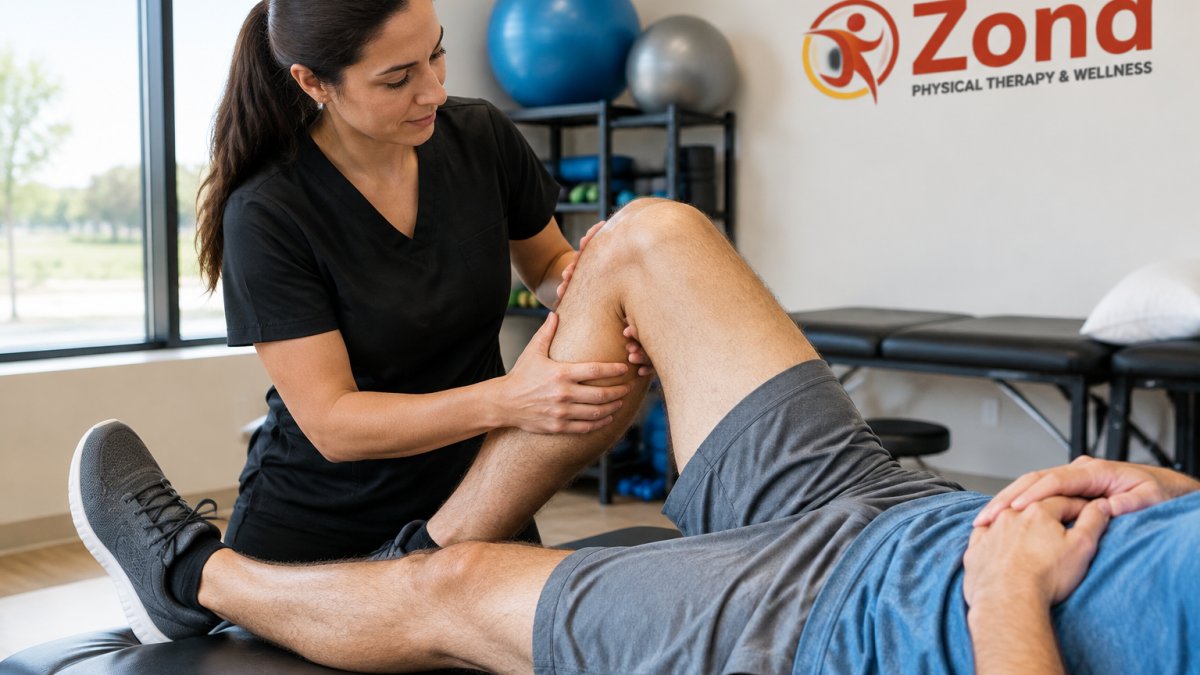
Your first visit is an assessment, not a workout. We ask about your pain history, what makes it worse, and what you want to get back to doing. Then we measure range of motion, strength, and how you walk, squat, and climb stairs. If you are recovering from knee surgery, our post-surgical rehabilitation in Buford page explains how that phase of care differs.
Physical Therapy Exercises for Knee Pain and Weakness
The best exercises for knee pain and weakness are the ones you can do with good form, at a level your knee tolerates, and repeat consistently. Progression matters more than intensity.

Most exercise lists stop at naming the movement.
Match the Exercise to the Likely Cause
Knee pain is not one condition, and the same exercise can help one person and irritate another. A few common patterns guide selection:
- Patellofemoral pain (pain around or under the kneecap, worse with stairs, squatting, or sitting long): quad sets, short-arc quads, glute bridges, and side-lying hip abduction usually come first. Deep knee bends and long sitting with the knee flexed tend to aggravate it early on.
- Knee osteoarthritis (aching, stiffness, morning pain that eases with movement, often in people over 50): range-of-motion work, quad strengthening in pain-free arcs, and low-impact conditioning such as stationary cycling or walking on level ground. Higher-impact loading is added gradually, not abandoned.
- Patellar or quadriceps tendon problems (pain at the top or bottom of the kneecap that worsens with loading and eases with rest): slow, heavy-ish strengthening through a limited range, plus isometrics such as a wall sit or Spanish squat hold, which can reduce pain without much joint movement.
A physical therapist sorts this out with hands-on testing rather than guesswork, because two people with pain in the same spot can need different starting points.
Quadriceps and Straight Leg Raises
The quadriceps muscle on the front of the thigh does most of the work of protecting the knee. Start with a quad set: sit with the leg straight, press the back of the knee down into the surface, hold five seconds, relax. Then try a straight leg raise: lie on your back, tighten the thigh, lift the straight leg about twelve inches, and lower it slowly.
Hip, Glute, and Hamstring Strengthening
Weak hips let the knee drift inward during walking and squatting, which irritates the joint over time. Glute bridges and clamshells build the gluteal muscles without loading the knee directly. Hamstring curls and calf raises round out the back of the leg. Step-ups, wall squats, and short-range lunges come later, once the basics feel controlled. Our therapists adjust the order based on what your evaluation shows.
How to Progress Without Flaring the Knee
Use one change at a time, and only when the current level feels controlled for two or three sessions in a row. A workable sequence looks like this:
- Add reps before resistance. Move from 2 sets of 10 to 3 sets of 10 before adding a band or weight.
- Add resistance in small steps. A light ankle weight or a thin resistance band is enough; you do not need to jump to the heaviest band in the drawer.
- Slow the tempo. A three-second lowering phase on a bridge or leg raise adds challenge without adding load.
- Narrow the base or go single-leg. Single-leg bridges and single-leg calf raises come after the two-leg version is easy and pain-free.
- Add range last. Deepening a squat or lunge is the final step, not the first.
A common pattern is to feel mild soreness for up to 24 hours after a new exercise. That is usually acceptable. Pain that climbs during the set, lingers past a day, or brings new swelling means the step was too big, drop back to the previous level for a week and try again.
Watch out: adding resistance, range, and speed in the same week makes it impossible to tell which change caused a flare, so change one variable at a time.
Physical Therapy for Knee Pain at Home: Sets, Reps, and Progression
A practical home program beats an ambitious one you abandon. Here is the framework we use:
| Exercise | Sets and Reps | Frequency | Progression Signal |
|---|---|---|---|
| Quad sets | 2 sets of 10, 5-second holds | Daily | Add a towel roll under the knee |
| Straight leg raises | 2 sets of 10 per leg | Daily | Add a light ankle weight |
| Glute bridges | 2 sets of 12 | 4-5 days a week | Progress to single-leg |
| Clamshells | 2 sets of 12 per side | 4-5 days a week | Add a resistance band |
| Hamstring curls | 2 sets of 12 | 3-4 days a week | Slow the lowering phase |
| Calf raises | 2 sets of 15 | Daily | Progress to single-leg |
Rest is part of the plan. Sharp pain during the exercise means back off. If you want realistic expectations for how long a full course of therapy takes, read our guide on how long physical therapy takes.
Knee Pain Exercises to Avoid and How to Modify Them
Deep squats, high-impact jumping, and running through pain are the usual culprits. They are not permanently banned, just poorly timed. The useful question is not which exercises are bad, but which version of an exercise your knee can handle right now. Here is how we modify the common ones:
| Movement | Why It Can Irritate | Modification to Try First |
|---|---|---|
| Deep squat | Large kneecap load at the bottom | Wall squat or box squat to a comfortable depth |
| Jumping / plyometrics | High impact and fast loading | Step-ups at a controlled pace, then low hops |
| Running through pain | Repetitive load with poor recovery | Walk-run intervals, or cycling and pool work |
| Long sitting with a bent knee | Sustained kneecap compression | Stand and straighten the knee every 20-30 minutes |
| Stairs, especially going down | Eccentric load on the quad | Lead with the stronger leg going up, the sore leg going down, one step at a time |
| Deep lunge | Combined knee bend and hip stretch | Short-range lunge, or split squat holding a rail |
For joint protection, keep the knee tracking over the middle toes and avoid locking it hard at full extension under load. A small amount of discomfort that settles within a day is generally acceptable; sharp pain during the movement is the signal to change the version, not to push through.
Watch out: pushing through sharp pain to "tough it out" often extends recovery rather than speeding it up, and repeatedly training into pain can turn a short-term flare into a longer one.
When Knee Pain Needs Medical Assessment Before Exercise
Some symptoms should be checked by a physician or urgent care before you start or continue an exercise program. Seek prompt medical assessment for:
- A knee that locks, catches, or cannot fully straighten
- A knee that gives way or feels unstable when you put weight on it
- Sudden, large swelling within a few hours of an injury
These signs can point to problems that exercise will not fix on its own, such as a ligament or meniscus injury, infection, or a blood clot. Once a physician has cleared you, physical therapy can pick up the rehab plan safely. If you are unsure whether your symptoms fit, call our clinic at 678-765-0909 and we will help you decide whether to start therapy or get medical clearance first.
Physical Therapy for Knee Pain Arthritis and Chronic Conditions
Arthritis changes the plan, not the goal. Mass General Brigham researchers reported that all trial participants with knee osteoarthritis, meniscal tear, and knee pain improved with exercise and physical therapy (EXTERNAL_LINK: study on knee pain improvement with exercise and physical therapy | massgeneralbrigham.org) (Study Finds Improvement in Knee Pain with Exercise and Physical Therapy). For arthritis-related knee pain, our arthritis and joint pain physical therapy page covers how we manage chronic conditions over the long term.
Book Your Knee Pain Evaluation at Zona Physical Therapy & Wellness
Exercises help most when they match your actual findings. Our guide on how to choose a physical therapist walks through the questions to ask. You can also review our knee pain physical therapy services to see how evaluation and treatment work.
Knee pain rarely resolves on its own when the underlying weakness goes unaddressed. At Zona Physical Therapy & Wellness, we build individualized plans around your goals, your history, and what your knee can tolerate today.
Frequently Asked Questions
What can a physical therapist do for knee pain?
A physical therapist assesses how you move, identifies strength and mobility gaps, and builds a plan around your goals. Treatment may include targeted exercises, manual therapy, gait training, and education on joint protection and load management. At Zona Physical Therapy & Wellness, sessions are one-on-one and last 45 to 60 minutes, so the plan reflects your clinical findings rather than a template.
Should you exercise with a sore knee?
Mild soreness during gentle movement is usually acceptable, but sharp pain, swelling, or pain that lingers hours after exercise means you should scale back and get it checked. Exercise is a core part of physical therapy for knee pain because it strengthens the muscles around the knee, but the dose matters. Start with low-load moves like quad sets and glute bridges, keep ranges comfortable, and progress only when symptoms stay calm for a day or two.
Which knee pain exercises should I avoid?
Skip deep lunges, full-depth squats, high-impact jumping, and heavy leg extensions when the knee is swollen or painful. These load the joint aggressively and can flare symptoms. Instead, modify with wall squats at a shallow angle, step-ups to a low platform, and controlled hamstring curls. A physical therapist can tell you which movements are safe for your specific knee injury and when to add load back in.
How long does physical therapy for knee pain take?
Timelines vary by cause and severity. Some people notice less pain within a few weeks of consistent exercise, while arthritis or post-surgical recovery can take several months. At Zona, your therapist sets milestones at the evaluation and adjusts the plan as you progress, so you know what to expect at each stage.
