

Last Updated: November 6, 2026
Quick Summary
Finding sports physical therapy in Buford starts with confirming the clinic treats athletes, not everyone the same way. Ask about the therapist's credentials, whether sessions are one-on-one, and how your insurance or auto accident claim will be billed before you book. Then book an evaluation and ask what your treatment goals and return-to-play tests will be.
- Ask how many athletes with your specific injury the therapist has treated this year.
- Confirm referral requirements, visit limits, and out-of-pocket costs with your insurer first.
- Tell the clinic up front if a car accident claim is involved, since billing paths differ.
- Return to sport should rest on side-to-side testing, not time since injury alone.
- Zona's one-on-one sessions run 45 to 60 minutes with a single therapist.
Table of Contents
- What to Look for in Sports Physical Therapy in Buford
- Step 1: Confirm Your Referral and Insurance Coverage
- Step 2: Ask These Questions During Your Initial Evaluation
- Step 3: Understand How Sports Injury Rehabilitation and Return to Sport Work
- Physical Therapy After a Car Accident: Why Timing Matters
- Whiplash Physical Therapy and Neck and Back Pain Rehabilitation
- Personal Injury Physical Therapy and Support for Attorneys
- Schedule Your Sports Physical Therapy Evaluation
- Frequently Asked Questions
What to Look for in Sports Physical Therapy in Buford
Finding sports physical therapy in Buford starts with one question: does this clinic treat athletes, or does it treat everyone the same way? A 2025 study of 216 people recovering from sports-related orthopedic injuries examined outcomes after at least four weeks of physical therapy, and the takeaway for patients is simple. The quality of the rehab plan matters as much as the injury itself. This guide from Zona Physical Therapy & Wellness walks you through the evaluation, the insurance questions, and the return-to-play decisions so you can choose with confidence.
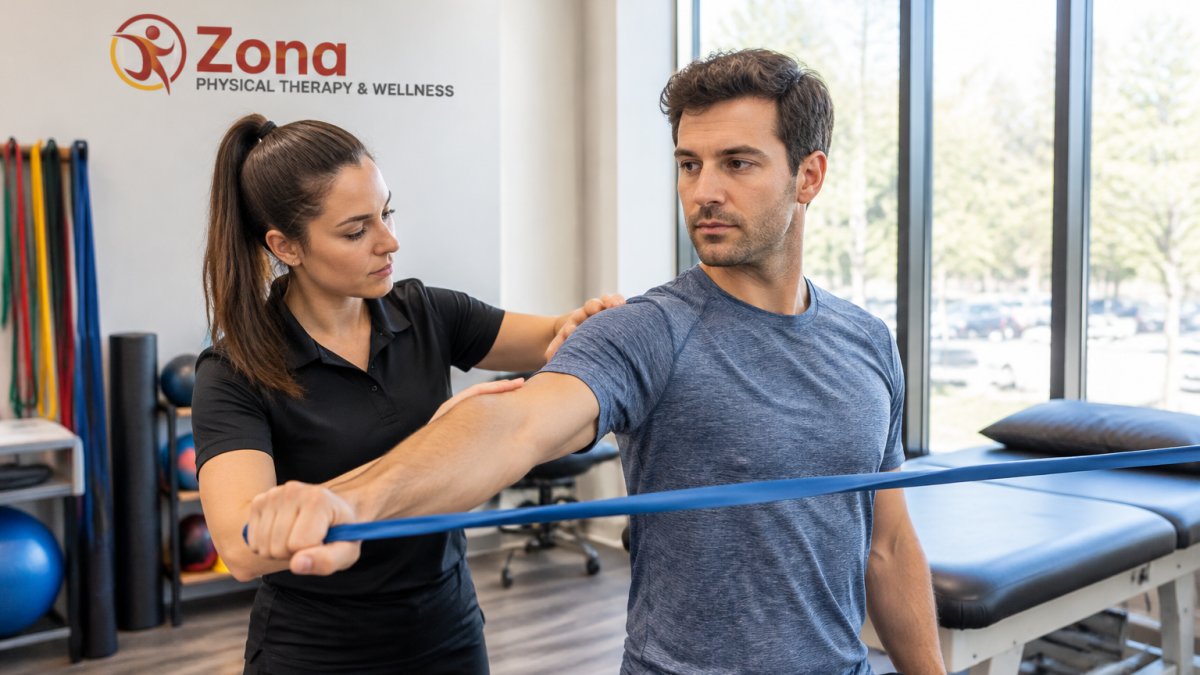
Sports physical therapy is a licensed clinician's program of hands-on treatment, therapeutic exercise, and sport-specific training designed to rebuild strength, range of motion, and stability after an injury.
Credentials and Sports Experience to Check
Ask whether your therapist holds a Doctor of Physical Therapy degree and whether they treat athletic injuries regularly. A clinician who works with runners, lifters, and overhead athletes every week will read your movement differently than a generalist. Ask directly: "How many athletes with my injury have you treated this year?"
One-on-One Care vs. Group Sessions
Individual sessions let a therapist adjust each exercise to your joint pain, endurance, and progress that day. Group sessions cost less but spread attention across several patients. For return-to-sport work, where small loading errors matter, one-on-one care is usually the better fit. Our own sessions run 45 to 60 minutes with a single therapist, and this article on why personalized physical therapy for athletes works explains the reasoning in more detail.
Step 1: Confirm Your Referral and Insurance Coverage
Before you book, call your insurer and ask three things: whether physical therapy requires a referral in your plan, what your visit limit is, and what your out-of-pocket responsibility looks like. Coverage for physical therapy depends on your specific plan. Write down the answers and bring them to your first visit.
- Confirm whether a physician referral is required
- Ask about the annual visit cap and any pre-authorization
- Get your copay or coinsurance amount in writing
- Ask whether the clinic is in network
How to Verify Your Benefits Without Wasting a Visit
A five-minute call to the member-services number on the back of your insurance card can save you a surprise bill later. Ask the representative to read you the physical therapy benefit verbatim and note the date, the representative's name, and a reference number for the call. If your plan requires a referral, ask whether a physician's office note or a formal referral order is sufficient, and how long the referral stays valid. If prior authorization is required, ask how many visits are approved at a time and what triggers a re-authorization. Ask your therapist to keep objective measures in the record from the first visit.
Auto Accident Claims Follow a Different Billing Path
If you were hurt in a crash, tell the clinic up front. Auto accident claims follow different billing paths than standard health insurance, and the front desk needs to know before your evaluation. Care may be billed through several different paths depending on your situation and policy. Ask the front desk before your first appointment which billing path they use, what documentation they provide to your attorney or insurer, and what authorizations they need on file. Bring your claim number, the adjuster's contact information, and your auto policy declarations page if you have them. Our auto accident and personal injury rehabilitation service explains how the first visit is structured when a claim is involved.
Watch out: a clinic that cannot clearly explain which billing path it will use for an auto accident claim is a clinic that may create documentation gaps later, ask before you book, not after your first visit.
Step 2: Ask These Questions During Your Initial Evaluation
Your first appointment should feel like an interview, not a sales pitch. A thorough patient evaluation includes a history of the injury, range of motion testing, strength and stability checks, and a movement assessment. Ask these questions before you commit to a plan:
- What is your working assessment of my injury, and what are the treatment goals?
- How many visits do you expect, and how will we measure progress?
- Which hands-on treatments and therapeutic exercises will we use, and why those?
- What should I do at home between sessions?
- What would make you change the plan?
A therapist who answers all five clearly, without rushing, is a good sign. Watch out: a clinic that hands you a printed protocol before examining you is treating a diagnosis, not a person.
Step 3: Understand How Sports Injury Rehabilitation and Return to Sport Work
Sports injury rehabilitation moves through phases: calming pain and restoring motion, rebuilding strength and stability, then loading the body for sport again. Early visits often center on manual therapy and gentle therapeutic exercise. Later visits add sport-specific movement, endurance work, and functional testing.
What Each Phase Actually Looks Like
Phase one is about quieting symptoms and restoring range of motion. Expect manual therapy, gentle mobility drills, and isometric exercises that load tissue without provoking pain. Phase two rebuilds strength and stability with progressive resistance training and balance work. Phase three loads the body for sport: sprinting mechanics, change-of-direction drills, plyometrics, and overhead or throwing progressions depending on your sport. A common pattern is that athletes feel ready in phase two but are not yet tissue-ready for phase three, the gap between "feels fine" and "cleared to compete" is where re-injury risk lives. (Source: The U.S. Department of Labor's Bureau of Labor Statistics)
Return-to-Play Criteria by Sport
Return to sport is a decision, not a date. Your therapist should test strength symmetry, stability, and confidence under load before clearing you. The specific tests differ by sport:
- Running and field sports: single-leg hop tests for distance and symmetry, a timed sprint, and a change-of-direction drill compared side to side.
- Overhead sports (tennis, swimming, throwing): shoulder range-of-motion symmetry, rotator cuff strength ratios, and a progressive throwing or serving program before full-intensity play.
- Strength and power sports (lifting, CrossFit): a graded return to loaded barbell movements, with attention to squat and hinge mechanics under fatigue.
- Court sports (basketball, volleyball): jump-landing mechanics, lateral shuffle speed, and repeated-effort tolerance.
Expect the timeline to vary by injury and by how consistently you complete home exercises. Completing the home program between visits is an important part of recovery. This guide to physical therapy timelines sets realistic expectations for how long rehab typically takes.
Questions to Ask Before You Are Cleared
Ask your therapist four questions before you return to full competition: which objective tests you passed and by what margin, what your re-injury risk looks like at your current loading level, what your warm-up and maintenance program should include for the first month back, and what symptoms should prompt you to stop and call. A therapist who answers all four with specific numbers and a written plan is giving you a real clearance, not a calendar date.
Watch out: a clinic that clears you based on time since injury alone, without side-to-side testing or sport-specific loading, is skipping the step that protects your season.
Return-to-play testing differs by sport, and the article lists the specific checks used for each.
| Sport type | Tests before clearance |
|---|---|
| Running and field sports | Single-leg hop tests, timed sprint, change-of-direction drill |
| Overhead sports (tennis, swimming, throwing) | Shoulder range-of-motion symmetry, rotator cuff strength ratios, throwing program |
| Strength and power sports (lifting, CrossFit) | Graded return to loaded barbell movements, squat and hinge mechanics |
| Court sports (basketball, volleyball) | Jump-landing mechanics, lateral shuffle speed, repeated-effort tolerance |
Physical Therapy After a Car Accident: Why Timing Matters
Starting physical therapy after a car accident early can help address stiffness before it worsens. Soft tissue injuries from a crash often produce stiffness and guarding that worsen over the first weeks, and delayed care can let movement patterns settle into compensation.
Whiplash is the classic example. Symptoms may not peak until a day or two after the collision, which is why many people feel fine at the scene and sore the next morning. If you notice neck stiffness, headaches, or restricted turning, get assessed rather than waiting it out. Our auto accident and personal injury rehabilitation service covers what that first visit involves.
Whiplash Physical Therapy and Neck and Back Pain Rehabilitation
Whiplash rehabilitation may combine hands-on treatment with graded exercise to address neck motion and muscle irritation. Neck and back pain rehabilitation follows the same logic: identify which movements provoke symptoms, rebuild tolerance gradually, and retrain posture and stability for daily activity. Manual therapy can ease stiffness, but the exercise program is what makes the change last.
Seek prompt medical attention if you have numbness or weakness in an arm or leg, severe headache, dizziness, or pain that worsens sharply. Those signs need a physician's review before rehab begins.
Personal Injury Physical Therapy and Support for Attorneys
Personal injury physical therapy produces two things at once: recovery for the patient and a clear clinical record. For attorneys, timely evaluation, consistent visit notes, and objective progress tracking are the foundation of clear clinical documentation.
Schedule Your Sports Physical Therapy Evaluation
The fastest way to find sports physical therapy in Buford that fits your recovery is to book an evaluation and ask the questions above. At Zona Physical Therapy & Wellness, we provide one-on-one sessions lasting 45 to 60 minutes, personalized treatment plans, and modern equipment in a single location. Browse the conditions we treat to confirm your injury fits, then call 678-765-0909 to schedule an evaluation.
Frequently Asked Questions
Is sports physical therapy covered by insurance?
Coverage depends on your specific plan, whether the visit is for a covered injury, and whether you have met your deductible. Most plans cover medically necessary physical therapy, but some require a referral or prior authorization. Call your insurer before your first visit and ask about visit limits and out-of-pocket costs. Confirm benefits directly with your carrier.
Do I need a referral to see a physical therapist in Georgia?
Whether a referral is needed depends on your insurance plan and state rules. Ask your insurer and the clinic before scheduling.
Can physical therapy help with neck or back pain after a car accident?
Yes. A licensed therapist can evaluate range of motion, strength, and movement patterns after a collision and build a plan that may include manual therapy, therapeutic exercise, and gradual functional activity. Symptoms such as neck pain can appear or worsen in the days after a crash. Call 678-765-0909 to schedule an evaluation at Zona Physical Therapy & Wellness in Buford.
What should I ask during my first sports physical therapy evaluation?
Ask who will treat you, how long each session lasts, and how progress will be measured. Confirm whether care is one-on-one and what return-to-sport criteria apply to your injury. Zona's sessions run 45 to 60 minutes with a single therapist.
Your recovery deserves a plan built around your body, not a template. Zona Physical Therapy & Wellness offers one-on-one care, hands-on treatment, and progress tracking that keeps you and your care team aligned from the first visit to your return to sport. Get started with Zona Physical Therapy & Wellness and take the first step toward moving better and feeling stronger.
