
Last Updated: November 4, 2026
Quick Summary
You can improve balance and prevent falls with a simple daily home routine done near a counter or sturdy chair, including single-leg stands, heel-to-toe walking, standing marches, sit-to-stands, side stepping and heel raises. Start easy, hold on as needed, and add difficulty only when a move feels steady.
- A study of nearly 8,000 older adults found balance and functional exercises cut falls by 24%.
- Hold a counter for single-leg stands, lifting one foot for 10-30 seconds, 3 times per leg.
- Do 10 heel-to-toe steps, then walk back, keeping heel touching toe.
- A review linked Tai Ji Quan to roughly 31% to 58% reductions in falls.
- The CDC's STEADI guidance advises reviewing medicines, checking eyes and feet, and making the home safer.
Table of Contents
- Balance Exercises for Seniors at Home: A Step-by-Step Routine
- Exercises to Improve Balance and Stability: Progression and Safety
- How to Prevent Falls at Home: Fall Prevention Tips for Older Adults
- Frequently Asked Questions
Balance Exercises for Seniors at Home: A Step-by-Step Routine
A study of nearly 8,000 older adults found balance and functional exercises cut falls by 24%, per Tufts University School of Medicine research. At Zona Physical Therapy & Wellness, we teach that a few simple daily moves build real steadiness. Here is how to improve balance and prevent falls with a safe home routine.
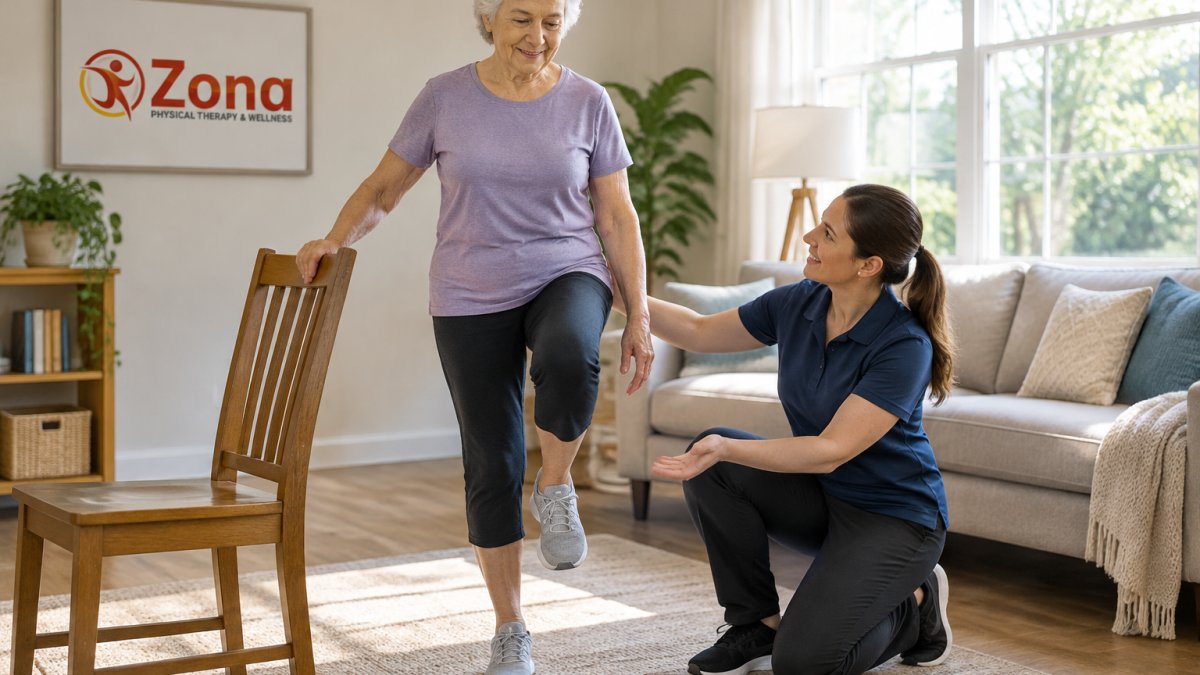
Do these near a counter or sturdy chair. Hold on as needed.
- Single-leg stand: Hold a counter, lift one foot, hold 10-30 seconds. 3 times per leg.
- Heel-to-toe walk: Heel touching toe, 10 steps, then back.
- Standing march: Hold a chair back, lift each knee slowly, 10 per side.
- Sit-to-stand: Stand from a chair without hands, 5-10 reps.
- Side stepping: 10 steps sideways, then back, slow and controlled.
- Heel raises: Hold a counter, rise onto toes, lower slowly, 10 reps.
Want guided, equipment-based sessions? Explore Pilates for structured balance work.
Here is the daily home routine, with how long or how many reps to do for each move.
| Exercise | How to do it | Time or reps |
|---|---|---|
| Single-leg stand | Hold a counter, lift one foot | 10-30 seconds, 3 times per leg |
| Heel-to-toe walk | Heel touching toe, then back | 10 steps |
| Standing march | Hold a chair back, lift each knee slowly | 10 per side |
| Sit-to-stand | Stand from a chair without hands | 5-10 reps |
| Side stepping | Step sideways, slow and controlled | 10 steps, then back |
| Heel raises | Hold a counter, rise onto toes, lower slowly | 10 reps |
Exercises to Improve Balance and Stability: Progression and Safety
Start easy and add difficulty only when a move feels steady, since gradual progression is a key safety principle. Hold a chair first, then go hands-free, and stop if dizzy.
A review linked Tai Ji Quan to roughly 31% to 58% reductions in falls, though the outcome measure is not specified, per PMC review of balance exercise. Mayo Clinic also notes tai chi may improve balance and stability. For one-on-one help, learn about balance and fall prevention physical therapy.
How to Prevent Falls at Home: Fall Prevention Tips for Older Adults
Exercise is only half the job. The CDC's STEADI guidance advises reviewing medicines, checking eyes and feet, and making the home safer, per the CDC STEADI brochure.
Quick home fixes: add grab bars in the bathroom, improve lighting in halls and stairways, remove loose rugs and clutter, wear nonslip footwear, and use night lights.
If walking feels unsteady, consider gait training for walking difficulties. Numbness or tingling? See physical therapy for neuropathy balance. These are general tips, not medical advice; a clinician decides what suits you.
Frequently Asked Questions
What is the number one exercise to increase balance in seniors?
There is no single best exercise, but the single-leg stand is a commonly used exercise for training balance. Stand behind a sturdy chair and hold the back for support. Lift one foot off the floor and hold for 10 seconds, working up to 30 seconds. Repeat on each leg. Research shows balance and functional exercises reduced falls by 24% in a study of nearly 8,000 older adults, so consistency matters more than any one move.
How often should older adults do balance exercises?
Aim for balance practice most days of the week, starting with 5 to 10 minutes and building gradually. The CDC recommends regular exercise to improve balance and strength as part of fall prevention. A progressive plan helps: begin with chair-supported moves like sit-to-stand and marching, then add single-leg stands and heel-to-toe walking as you feel steadier. Stop if you feel unsteady and use a counter or chair for support.
Can balance exercises be done safely at home?
Yes, most balance exercises can be done safely at home with a sturdy chair, counter, or wall nearby for support. Clear the area of rugs and clutter, wear nonslip shoes, and start with supported moves. If you have had a recent fall, use an assistive device, or feel unsteady during exercise, talk with a qualified healthcare professional about your situation.
Steady balance is built one small step at a time, and it is worth starting today. At Zona Physical Therapy & Wellness, our one-on-one sessions last 45 to 60 minutes and are tailored to your needs. We offer physical therapy, Pilates, and wellness services under one roof. Get started with Zona Physical Therapy & Wellness and build strength, balance, and control with a plan made for you.
